
Have you ever been on a dance floor, completely lost in the moment, when suddenly the music jarringly changes? One moment you are singing your heart out to a 90s classic, and the next, a completely different genre slams in at a different tempo. The rhythm is lost. Your feet stop moving. You look at your friends, shrug, and head to the bar.
That moment of confusion is caused by a poor transition.
In the world of Professional wedding DJ services, the transition is everything. It is the invisible thread that stitches a night of music together. When done correctly, you shouldn’t even notice it happening. When done poorly, it can derail the entire energy of a party.
At The Fire DJs, we believe that understanding the mechanics of DJing helps couples make better decisions when booking their entertainment. If you are looking for a Portland wedding DJ, a Seattle wedding DJ, or entertainment anywhere in the PNW, this guide will pull back the curtain on the technical skills that separate the amateurs from the pros.
The Anatomy of a Transition
Most people think DJing is just picking good songs. While song selection is crucial, the delivery of those songs is what defines the experience. A transition is the bridge between Track A (the song currently playing) and Track B (the song coming next).
For Best wedding DJs, this isn’t just about fading one volume fader down and another one up. It involves a complex interplay of mathematics, musical theory, and timing.
1. Beatmatching
This is the foundational skill of any DJ who mixes live. Every song has a tempo, measured in Beats Per Minute (BPM).
- Track A might be a disco track at 120 BPM.
- Track B might be a modern pop song at 124 BPM.
If a DJ were to just play them simultaneously, the drum beats would clash, sounding like shoes in a dryer. To transition smoothly, the DJ must adjust the pitch/speed of Track B to match Track A exactly. When the beats are aligned (or “locked”), the two songs can play on top of each other seamlessly, creating a unified rhythm.
2. Phrasing
Music is structured in “phrases,” usually blocks of 8, 16, or 32 beats (often called “bars”). A Professional wedding DJ knows that you can’t just mix a song in anywhere. You have to align the phrases.
- You want the chorus of the incoming song to hit exactly when the chorus of the outgoing song ends.
- Or, you want the build-up of the new track to start exactly as the old track begins its breakdown.
When phrasing is off, the energy feels awkward. When it is locked in, the transition feels inevitable and satisfying.
3. EQ Mixing (Equalization)
The “Low,” “Mid,” and “High” knobs on a DJ mixer aren’t just for decoration.
- Low: Bass and kick drums.
- Mid: Vocals and guitars.
- High: Hi-hats and snares.
You generally cannot have the bass lines from two different songs playing at full volume simultaneously; the frequencies will clash and distort the sound system. A skilled Wedding reception DJ will carefully swap the bass lines—fading the bass out of the old song while bringing the bass of the new song in—to keep the bottom end of the mix clean and punchy.
Why The Transition Technique Matters for Your Wedding
You might be thinking, “This sounds technical, but does it really matter for my wedding?” The answer is a resounding yes. Here is why the quality of transitions directly impacts the success of your Wedding DJ services.
1. Maintaining Momentum
The primary goal of a High-energy wedding DJ is to keep the dance floor packed. Momentum is fragile. A silence of even three seconds is enough for a guest to decide they are tired. A smooth beatmatch keeps the pulse of the room alive. It tells the guests’ bodies to keep moving before their brains have time to decide otherwise.
2. Building Trust with the Crowd
DJs who read the crowd use transitions to earn trust. If a DJ slams from a fast song into a slow song without warning, the crowd feels jerked around. Smooth transitions guide the crowd gently from one vibe to another. It signals, “I know where we are going, trust me.”
3. Creating Unique Moments
A great transition creates a “remix” live in the moment. Hearing the vocals of a beloved throwback track layered over the beat of a current hit creates a unique musical moment that your guests have never heard before. It makes the night feel exclusive and tailored, rather than a generic playlist.
Different Types of Transitions (And When We Use Them)
Not every song needs a long, blended mix. Best PNW wedding DJ talent knows which tool to use for which job.
The Long Blend (The Smooth Operator)
- What it is: The DJ matches the beat and lets both songs play together for a minute or more, slowly swapping frequencies.
- Best for: House music, EDM, and keeping a high-energy dance groove locked in.
- Why we use it: It creates a hypnotic, club-like atmosphere. It is perfect for later in the night when the party is peaking.
The Drop Mix (The “Slam”)
- What it is: Cutting instantly from one song to the chorus or “drop” of another on the “one” count (the first beat of a measure).
- Best for: Hip-hop, Top 40, and high-impact anthems.
- Why we use it: It creates instant excitement. If the crowd is singing along to a verse, and we suddenly slam into the chorus of a massive hit, the energy spikes immediately.
The Echo Out
- What it is: Using an effect to make the outgoing song echo away into silence while starting the new track.
- Best for: Changing genres drastically (e.g., going from 128 BPM dance music down to 90 BPM hip-hop).
- Why we use it: Sometimes you need to reset the tempo. The echo provides a “tail” to the sound so it doesn’t feel like an abrupt stop, allowing us to pivot to a new vibe.
The Wordplay Transition
- What it is: Connecting two songs based on a shared lyric or theme. For example, mixing a song that ends with the word “Stop” into “Can’t Stop the Feeling.”
- Best for: Clever moments that make the crowd go “Ohhh!”
- Why we use it: It shows personality and creativity. This is a hallmark of Non-cheesy wedding DJs who use musical skill rather than microphone chatter to entertain.
The “Sync Button” Debate: Modern Technology vs. Skill
In the world of Modern wedding DJs, technology has advanced rapidly. Most professional software has a “Sync” button that can automatically match the tempo of two songs.
Does using Sync make a DJ “fake”? Not necessarily.
At The Fire DJs, we believe that ears are more important than buttons. While technology helps, it isn’t perfect. Computers often misanalyze the beat of older songs (like Motown or 80s rock), which are played by human drummers and naturally fluctuate in tempo.
A Professional wedding DJ must know how to beatmatch manually. If the software fails—and it does—the DJ needs to be able to fix the mix by ear instantly. Relying 100% on a computer is dangerous. We use technology to enhance our creativity, not to do the job for us.
Transitions and Genres: The Challenge of Multicultural Weddings
The true test of a DJ’s transition skills comes during diverse events. We specialize as a DJ for multicultural weddings, where we might need to mix Bhangra into Hip-Hop, or Latin Pop into Country.
These genres have different rhythmic structures. A standard 4/4 house beat doesn’t mix easily with a salsa rhythm. This requires advanced techniques like “looping” (taking a small section of a beat and repeating it) to create a bridge between cultures.
For example, our DJ Sai Aguru (read more about him on our About Page) is a master of blending South Asian music with American Top 40. This isn’t just pressing play; it requires a deep understanding of the musical structure of both cultures to ensure the transition respects both styles.
Being an LGBTQ+ friendly wedding DJ also means understanding the nuances of different musical subcultures. From disco anthems to modern hyper-pop, the ability to weave these threads together relies entirely on transition technique.
Why Cheap DJs Don’t Transition (And What It Costs You)
When you are researching Wedding DJ cost / pricing, you will find a wide range of quotes. You might find an Affordable wedding DJ near me who charges significantly less than the market average.
Often, the difference lies in this specific skill set.
Cheap DJs often act as “human jukeboxes.” They simply play a song until it ends, wait a second, and play the next one. They may use a generic “auto-fade” setting.
- The Result: The energy constantly resets. Guests leave the floor during the silence. The night feels disjointed.
Higher-end Wedding DJ packages include the talent of a turntablist or a mixing DJ. You are paying for the thousands of hours of practice it took to master beatmatching, phrasing, and EQing.
- The Result: A seamless, high-energy experience where guests lose track of time because the music never stops.
Transitions Beyond the Dance Floor
While we focus on the dance floor, transitions matter throughout the entire event.
The Ceremony
A Wedding ceremony music DJ deals with the most critical transitions of the day.
- The transition from the “seating music” to the “processional” must be smooth and timed perfectly to the arrival of the wedding party.
- The transition from the “vows” to the “recessional” (exit song) must be instantaneous. The moment the officiant says, “You may kiss the bride,” the music needs to swell immediately to capture that joyful energy. A delay of three seconds here feels like an eternity.
The Cocktail Hour and Dinner
Even during background music, transitions matter. If the volume jumps up and down between songs, guests get annoyed. A steady, consistent flow of music (using normalization and smooth fades) allows conversation to flow naturally without interruption.
Equipment: The Tools of the Trade
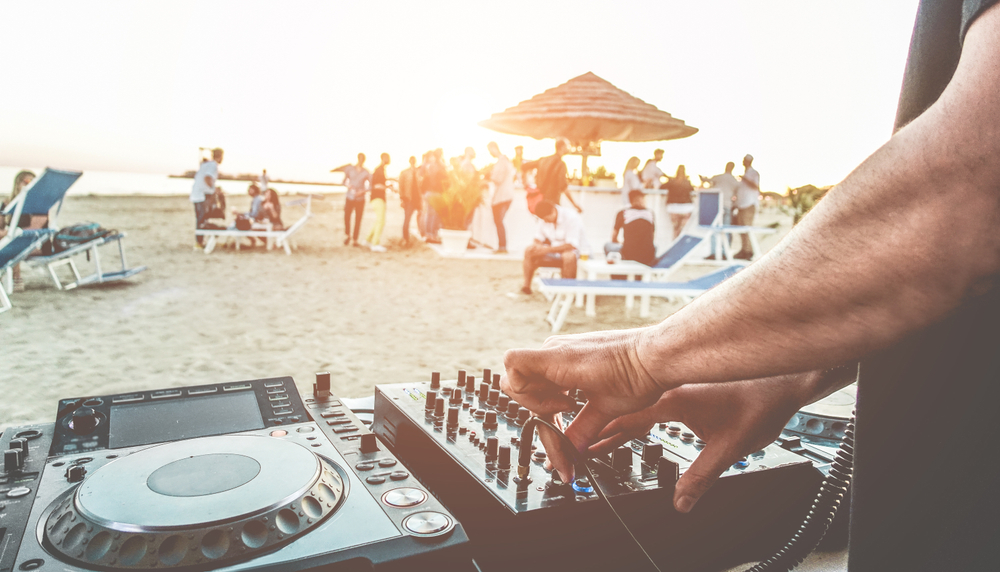
To execute these transitions, we rely on professional gear. You can’t perform complex beatmatching on a phone.
Our setups typically include:
- Controllers/Turntables: These allow us to physically manipulate the music, speeding it up, slowing it down, or “scratching” it in.
- Performance Mixers: High-end mixers with isolated frequency controls and high-quality effects.
- Software: Serato or Rekordbox, the industry standards for professional performance.
We also offer DJ with lighting packages where the lights are synchronized to these transitions. When we execute a “Drop Mix,” the lights can change color or strobe instantly, reinforcing the musical change with a visual impact.
Furthermore, our DJ + photobooth packages ensure that the entertainment ecosystem is cohesive. The photobooth creates a buzz that feeds back onto the dance floor, and our smooth transitions ensure that when guests step out of the booth, they are pulled right back into the dance circle.
Regional Expertise: Knowing the PNW Vibe
Transitions aren’t just technical; they are cultural. A Portland wedding entertainment crowd might appreciate a transition from 90s Grunge into modern Indie Pop—a mix that might not work in Miami or New York.
- Portland Wedding DJ: We often mix eclectic genres. Transitioning from Lizzo to The Talking Heads requires finesse, but Portland crowds love it.
- Seattle Wedding DJ: In Seattle, there is often a stronger influence of electronic and hip-hop music. Best wedding DJs in Seattle need to be able to mix fast-paced tempos smoothly.
- Tacoma Wedding DJ: The vibe here is often high-energy and unpretentious. Wedding DJ Tacoma WA sets often rely on quick, impact-based transitions to keep the party rocking.
- Vancouver WA Wedding DJ: Across the river, Vancouver wedding entertainment often bridges the gap between country/rock and pop. Smoothly mixing a two-step beat into a dance track is a specific skill we have mastered.
Whether you need a Wedding DJ Seattle WA expert or the Best Portland wedding DJs, The Fire DJs team understands the local musical dialect.
Questions to Ask Your Potential DJ
To ensure you are hiring a DJ who understands transitions, ask these questions during your consultation:
- “How do you mix between songs?” (Listen for terms like “beatmatching,” “phrasing,” or “harmonic mixing”).
- “Do you use a pre-set playlist or do you mix live?” (A pre-set playlist implies no live transitions).
- “Can you handle a transition between two very different genres?” (Ask them specifically about genres you like, e.g., “Can you mix Country into Hip-Hop?”).
- “Do you have mixes I can listen to?”
(You can check out our DJs’ styles on our Services Page or read Reviews from couples who have experienced our mixing firsthand).
The Role of the MC
It is worth noting that Wedding MC services are also a form of transition. The MC transitions the event from one activity to another (e.g., from Dinner to Toasts).
Just like a musical transition, an MC transition needs to be smooth, clear, and perfectly timed. We don’t just grab the mic and yell; we wait for a lull in the music, lower the volume smoothly, make the announcement clearly, and bring the music back up. The flow of information is just as important as the flow of beats.
Conclusion: The Art of the Seamless Party
At the end of the day, your guests won’t leave your wedding talking about “beatmatching” or “EQ isolation.” They won’t know that we transitioned at the 32-bar phrase change.
They will say, “I couldn’t stop dancing.”
They will say, “The music was incredible.”
They will say, “That was the best party I’ve ever been to.”
That is the power of the transition. It is the invisible art that makes the magic happen.
If you are looking for Wedding DJ services that prioritize skill, energy, and professionalism, we would love to be part of your team. Whether you need an Outdoor wedding DJ for a summer celebration or a full indoor production, The Fire DJs brings the technical expertise to make your night flawless.
Ready to keep the beat going?
Contact us today to check availability for your date. Let’s create a playlist that never stops.

